Pearls of Song
The sea, remembered in a voice.
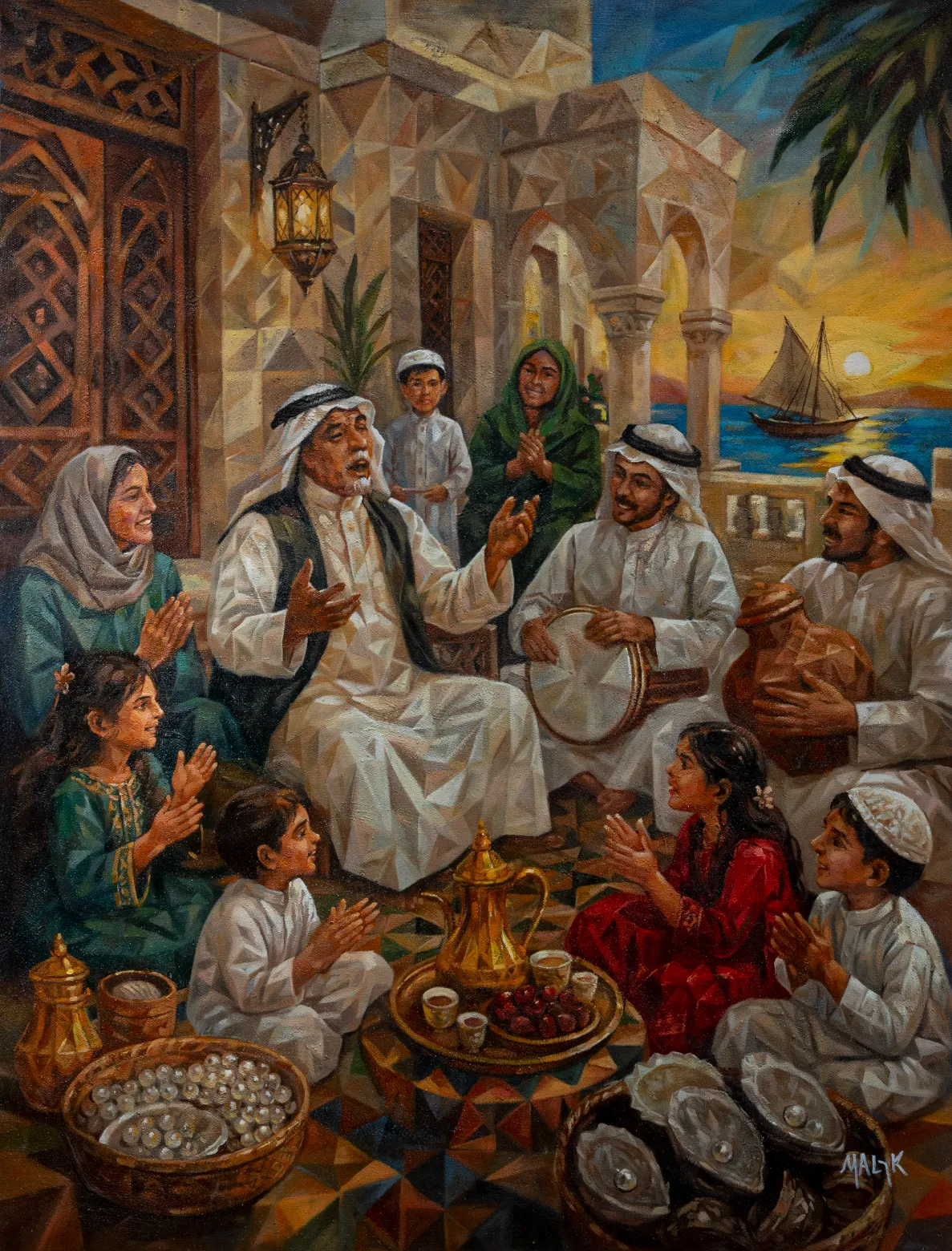
Music carries Bahrain’s relationship with the sea into the present. A gathering of performers and family connects maritime memory with the pleasure of shared rhythm. The work looks towards the voices, gestures and relationships that sustain a community.
A lead singer, younger musicians and family members gather within a maritime setting. Rhythm and gesture animate the space against a quiet horizon.
The catalogue draws on Fjiri, a musical tradition connected with Bahrain’s pearling communities. Coral-stone architecture, a Muharraq courtyard and glimpses of dhow masts place the gathering within that coastal world.
The painting considers what a community carries from its relationship with the sea: songs, shared knowledge and ways of being together. Younger musicians become part of that continuing story.
Bahrain's relationship with the sea is expressed through music in Pearls of Song. Rather than focusing solely upon the hardship historically associated with pearl diving, Malak turns to Fjiri, the collective musical tradition connected to Bahrain's pearling communities.
A lead singer performs alongside younger musicians while family members gather nearby. Rhythm moves through the composition — drums, finger chimes, gesture and voice establishing a visual cadence against the still horizon of the Gulf. Fjiri was inscribed by UNESCO in 2021 and remains deeply connected to Bahrain's maritime history.
Malak places the gathering within, or near, a Muharraq courtyard, surrounded by coral-stone architecture and the suggestion of dhow masts beyond. A pearl shell, clay water vessel or traditional musical object links the performance back to earlier generations, while sea water, oyster shells and date palms create the natural vocabulary of the painting.
The pearl itself becomes almost secondary. What interests Malak is the culture that developed around its pursuit: songs, specialised knowledge, community structures and collective memory. Bahraini sand incorporated into the shoreline and architectural surfaces connects that maritime world physically to the island.
Pearls of Song celebrates Bahrain not through the object recovered from beneath the water, but through the voices that remained above it.
Stories in the Majlis